
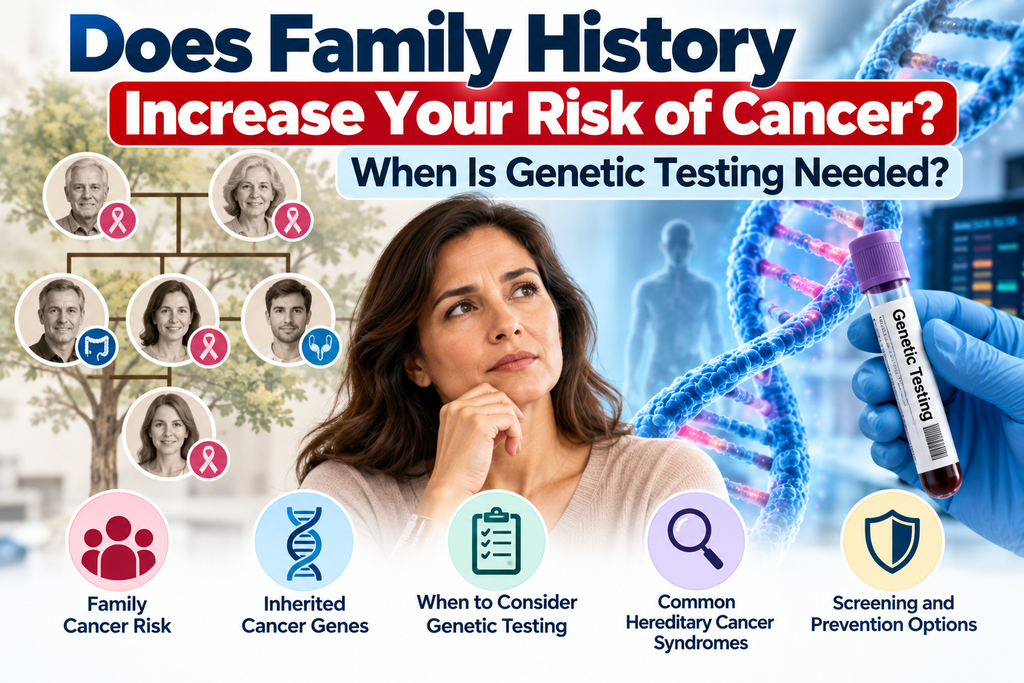
If a parent, sibling, or close relative has had cancer, you may wonder:
“Does this mean I am more likely to develop cancer?”
The answer is: sometimes, but not always.
Having a family history of cancer can increase a person’s risk, particularly when several close relatives have developed the same or related cancers, when cancer occurs at an unusually young age, or when certain patterns of cancer appear across generations.
However, most cancers are not caused by an inherited genetic change. Cancer can develop because of a combination of inherited factors, environmental exposures, lifestyle factors, aging, and changes that occur in cells during a person’s lifetime.
Understanding your family history can help doctors determine whether genetic counseling or genetic testing may be appropriate.
What Does Family History of Cancer Mean?
A family history of cancer means that one or more biological relatives have been diagnosed with cancer.
Doctors may consider:
- Which relatives had cancer
- The type of cancer
- Their age at diagnosis
- Whether cancers occurred on your mother’s or father’s side
- Whether multiple relatives had related cancers
- Whether one person developed more than one type of cancer
- Whether cancer occurred at an unusually young age
Not every family history indicates an inherited cancer syndrome.
Sometimes several family members develop cancer simply because cancer is common, because relatives share environmental or lifestyle exposures, or because they have lived to older ages.
Does Cancer Run in Families?
Some cancers can run in families.
A small proportion of cancers are caused primarily by inherited genetic changes that increase cancer risk.
These inherited changes are called germline variants because they are present in the body’s cells and can potentially be passed from one generation to another.
Examples of inherited cancer-predisposition genes include:
- BRCA1
- BRCA2
- TP53
- APC
- MLH1
- MSH2
- MSH6
- PMS2
- EPCAM
- PTEN
- CDH1
The significance of a genetic variant depends on the specific gene and the particular variant.
What Is an Inherited Cancer Syndrome?
An inherited cancer syndrome is a condition in which a genetic change increases a person’s likelihood of developing certain cancers.
Examples include:
Hereditary Breast and Ovarian Cancer Syndrome
Often associated with inherited changes in BRCA1 or BRCA2.
These genes are associated with increased risks for certain breast, ovarian, pancreatic, prostate, and other cancers.
Lynch Syndrome
Lynch syndrome is associated with inherited changes in DNA mismatch-repair genes such as MLH1, MSH2, MSH6, and PMS2, as well as EPCAM-related mechanisms.
It can increase the risk of colorectal cancer and several other cancers.
Familial Adenomatous Polyposis
This condition is commonly associated with inherited changes in the APC gene and can cause numerous colorectal polyps and a substantially increased risk of colorectal cancer.
Li-Fraumeni Syndrome
This rare hereditary cancer syndrome is associated with TP53 variants and can increase the risk of several cancer types, sometimes at younger ages.
These are only examples. There are many other hereditary cancer syndromes.
How Do You Know If Cancer in Your Family May Be Hereditary?
Certain family patterns may raise suspicion of an inherited cancer risk.
Examples include:
1. Cancer at a Young Age
Cancer diagnosed unusually early may sometimes indicate an inherited predisposition.
2. Several Close Relatives With Cancer
If multiple biological relatives have related cancers, genetic counseling may be appropriate.
3. The Same Cancer Across Several Generations
A pattern of similar cancers appearing in grandparents, parents, siblings, or children may be significant.
4. Multiple Cancers in One Person
Someone who develops more than one primary cancer may sometimes have an inherited predisposition.
5. Rare Cancers
Certain uncommon cancers can be associated with hereditary syndromes.
6. Related Cancers
Some inherited syndromes increase the risk of several different but biologically related cancers.
For example, a family may have a pattern involving breast, ovarian, pancreatic, or prostate cancers.
Does Having a Parent With Cancer Mean You Will Get Cancer?
No.
Having a parent with cancer does not mean that you will definitely develop cancer.
Even when a hereditary cancer syndrome is present, inheriting a cancer-predisposition variant generally means the person has an increased risk, not a certainty that cancer will develop.
Risk depends on the specific gene, variant, cancer type, family history, environmental factors, and other circumstances.
What Is Genetic Testing for Cancer?
Cancer genetic testing can mean different things.
Germline Genetic Testing
This looks for inherited genetic changes that may increase cancer risk.
A sample may be obtained from:
- Blood
- Saliva
- Other appropriate specimens
Germline testing can help determine whether a person has an inherited cancer-predisposition variant.
Tumor Genetic Testing
Tumor testing examines genetic or molecular changes in the cancer itself.
These changes may have developed during a person’s lifetime and may not be inherited or passed to children.
Tumor testing can sometimes help doctors select targeted therapies or other treatments.
Germline testing and tumor testing are not the same thing.
When Should Someone Consider Genetic Counseling?
Genetic counseling can be useful when a person’s personal or family history suggests a possible inherited cancer risk.
Situations that may prompt referral include:
- Cancer diagnosed at a young age
- Multiple close relatives with cancer
- Several relatives with related cancers
- Certain rare cancers
- Multiple primary cancers in one person
- A known pathogenic genetic variant in the family
- Cancer patterns suggesting a hereditary syndrome
A genetic counselor or appropriately trained healthcare professional can review the family history and determine whether testing may be useful.
What Happens During Genetic Counseling?
Genetic counseling usually begins with a detailed review of your personal and family medical history.
You may be asked about:
- Parents
- Siblings
- Children
- Grandparents
- Aunts and uncles
- Cancer types
- Ages at diagnosis
- Previous genetic testing
The counselor may then explain:
- Your estimated hereditary risk
- Whether genetic testing is appropriate
- What the test can and cannot tell you
- Possible results
- Implications for family members
- Potential medical follow-up
Genetic counseling can help people make informed decisions about whether testing is appropriate for them.
What Can Genetic Testing Results Mean?
Genetic testing can produce several types of results.
Positive Result
A pathogenic or likely pathogenic variant associated with increased cancer risk is identified.
This may lead to additional screening, preventive strategies, or discussions about risk-reducing treatment depending on the gene and individual circumstances.
Negative Result
No relevant pathogenic variant is identified.
A negative result does not always mean that a person’s cancer risk is average, particularly when there is a strong family history.
There may be genetic factors that current testing cannot identify, or the family history may be explained by factors other than a known inherited variant.
Variant of Uncertain Significance
Sometimes testing identifies a genetic change whose significance is not yet known.
A variant of uncertain significance (VUS) generally should not be treated as proof that a person has a hereditary cancer syndrome.
The interpretation may change as scientific knowledge develops.
What Happens If Genetic Testing Finds an Inherited Risk?
A positive result does not mean that cancer is inevitable.
Instead, it can provide useful information about cancer risk and may allow doctors to consider appropriate strategies.
Depending on the gene and cancer risk, these may include:
- Earlier or more frequent cancer screening
- Specialized imaging
- Risk-reducing medications in selected situations
- Preventive surgery in selected high-risk conditions
- Lifestyle and risk-factor counseling
- Testing or counseling for relatives
The appropriate approach depends on the specific genetic finding.
Should Family Members Get Tested?
Sometimes.
If a pathogenic inherited variant is identified, biological relatives may have an increased chance of carrying the same variant.
In these situations, cascade genetic testing may be considered for appropriate family members.
Testing should ideally be discussed with a genetic counselor or healthcare professional who can explain the implications.
Can Genetic Testing Predict Exactly Who Will Get Cancer?
No.
Genetic testing can identify certain inherited risk factors, but it generally cannot predict with certainty whether an individual will develop cancer or exactly when it will occur.
Cancer risk is influenced by multiple factors.
A genetic result is one piece of information that should be interpreted alongside personal history, family history, screening results, and other risk factors.
Can Genetic Testing Help With Cancer Treatment?
Yes, in some situations.
There are two major reasons genetic information may be used in oncology:
Inherited genetic testing can identify hereditary cancer risk and may sometimes influence treatment decisions.
Tumor biomarker testing can identify molecular features of a cancer that may help doctors select targeted therapy, immunotherapy, or other treatments.
The appropriate testing depends on the type and stage of cancer.
What Should You Do If Cancer Runs in Your Family?
Start by building a detailed family cancer history.
Try to find out:
- Who had cancer?
- What type of cancer did they have?
- How old were they when diagnosed?
- Which side of the family were they from?
- Did anyone have more than one cancer?
- Has anyone undergone genetic testing?
- Was a hereditary mutation identified?
Share this information with your doctor.
A healthcare professional can determine whether you may benefit from genetic counseling or additional screening.
Can Lifestyle Still Matter If Cancer Runs in the Family?
Yes.
Having an inherited risk does not make lifestyle and environmental factors irrelevant.
Depending on individual circumstances, cancer prevention strategies may include:
- Avoiding tobacco
- Maintaining a healthy weight
- Staying physically active
- Limiting alcohol
- Eating a balanced diet
- Protecting skin from excessive ultraviolet exposure
- Following recommended cancer screening
- Managing relevant health conditions
However, healthy habits cannot completely eliminate inherited cancer risk.
Why Early Detection Matters
For people with an increased risk of certain cancers, appropriate screening may allow cancer or precancerous changes to be detected earlier.
Screening recommendations vary according to:
- Age
- Sex
- Personal medical history
- Family history
- Genetic findings
- Cancer type
- Previous test results
People with hereditary cancer syndromes may need screening that begins earlier or occurs more frequently than routine population screening.
Questions to Ask Your Doctor
If cancer runs in your family, consider asking:
- Does my family history suggest an inherited cancer risk?
- Should I see a genetic counselor?
- Do I need germline genetic testing?
- Which genes should be tested?
- What would a positive result mean?
- What would a negative result mean?
- What is a variant of uncertain significance?
- Would my relatives need testing?
- Should I begin cancer screening earlier?
- Do I need additional or more frequent screening?
The Bottom Line
A family history of cancer can increase your risk, but having relatives with cancer does not mean you will definitely develop cancer.
Certain patterns—such as multiple close relatives with related cancers, unusually young diagnoses, rare cancers, or a known inherited mutation—may suggest the possibility of a hereditary cancer syndrome.
Genetic counseling can help determine whether genetic testing is appropriate.
If testing identifies an inherited cancer-predisposition variant, it may help doctors develop a personalized screening and risk-management plan and may provide important information for other family members.
If cancer runs in your family, don’t panic. Start by understanding your family history and discussing it with a qualified healthcare professional or genetic counselor.
Frequently Asked Questions
Does having a family history of cancer mean I will get cancer?
No. A family history can increase risk in some situations, but it does not mean cancer is inevitable.
How many relatives need to have cancer before genetic testing is recommended?
There is no single number. The type of cancer, age at diagnosis, relationship between relatives, and pattern across the family are all important.
At what age should genetic testing be done?
There is no universal age. Testing is based on personal and family history, the suspected hereditary syndrome, and clinical recommendations.
Is genetic testing the same as a cancer test?
No. Genetic testing can look for inherited variants associated with cancer risk. It does not simply determine whether you currently have cancer.
What happens if my genetic test is positive?
A positive result may indicate an increased risk for certain cancers. Your healthcare team may recommend specific screening, preventive strategies, or other risk-management options.
What if my genetic test is negative?
A negative result does not always mean your cancer risk is average. If there is a strong family history, your doctor may still recommend additional screening or evaluation.
Can genetic testing prevent cancer?
The test itself does not prevent cancer. However, identifying an inherited risk can allow appropriate screening and preventive strategies to be considered.
Should my children be tested?
It depends on the specific genetic finding, the condition involved, and the child’s age. Discuss family testing with a genetic counselor or qualified healthcare professional.
Medical Disclaimer:
This article is intended for general educational purposes only and does not replace professional medical advice, diagnosis, genetic counseling, or treatment. Genetic testing and cancer screening recommendations should be based on an individual’s personal and family history and discussed with a qualified healthcare professional.