
Hearing the words “You have cancer” can be overwhelming. Many patients immediately wonder:
“What happens next?”
After a cancer diagnosis, treatment usually does not begin with a single decision. Doctors first need to understand exactly what type of cancer it is, how advanced it is, where it is located, and what biological features it has.
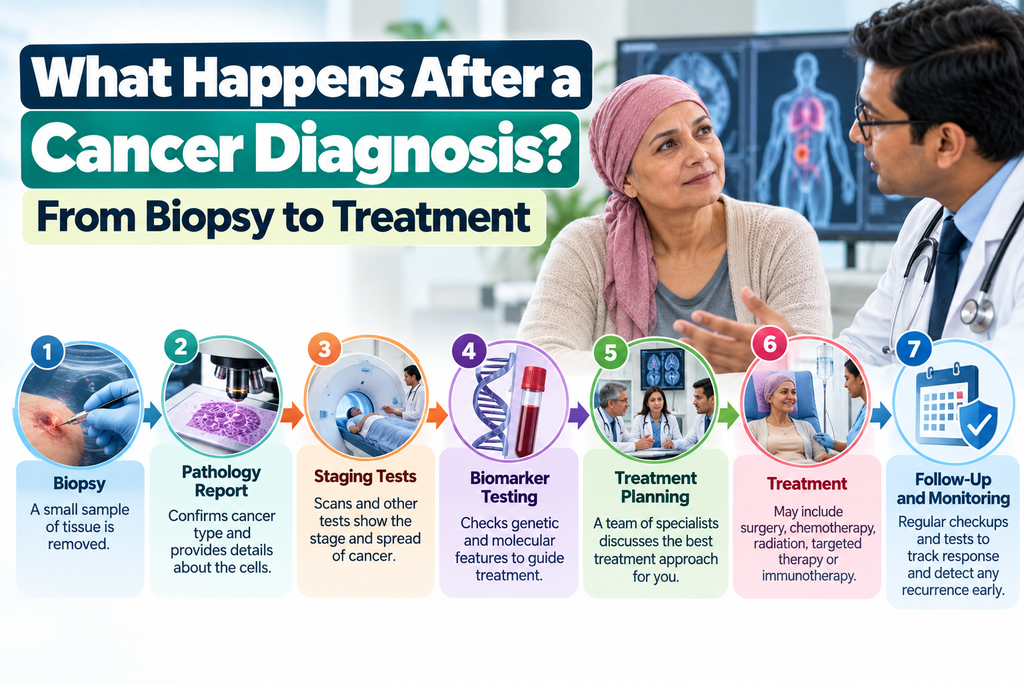
The journey often includes pathology review, staging tests, biomarker testing, multidisciplinary evaluation, treatment planning, and ongoing monitoring.
Understanding these steps can make the process feel more manageable and help patients prepare for conversations with their healthcare team.
Step 1: Confirming the Cancer Diagnosis
In many cases, cancer is confirmed through a biopsy.
During a biopsy, a doctor removes a small sample of tissue or cells from an area that looks abnormal. A pathologist examines the sample under a microscope and may perform additional tests.
The pathology report can help determine:
- Whether cancer is present
- The type of cancer
- The cancer subtype
- How abnormal the cells look
- Certain features that may affect treatment
A biopsy is often one of the most important steps because treatment depends heavily on the exact diagnosis.
What Is a Pathology Report?
A pathology report summarizes what the pathologist found in the tissue sample.
Depending on the cancer, it may include information about:
- Tumor type
- Tumor grade
- Tumor size
- Lymph node involvement
- Surgical margins
- Receptor status
- Molecular or genetic characteristics
The terminology can be difficult to understand, so patients should ask their doctor to explain unfamiliar terms.
Step 2: Determining the Cancer Stage
Once cancer has been confirmed, doctors usually determine its stage.
Staging describes how extensive the cancer is and whether it has spread to other parts of the body.
For many solid cancers, staging considers:
- T — Tumor: size and extent of the primary tumor
- N — Nodes: whether nearby lymph nodes contain cancer
- M — Metastasis: whether the cancer has spread to distant organs
The exact staging system varies depending on the cancer type.
Why Is Cancer Staging Important?
Staging helps doctors:
- Understand how extensive the disease is
- Estimate prognosis
- Select appropriate treatment
- Determine whether surgery may be possible
- Compare treatment outcomes
- Communicate consistently about the diagnosis
For example, treatment for an early-stage cancer may be very different from treatment for cancer that has spread to distant organs.
Step 3: Imaging and Other Tests
Doctors may order additional tests to understand where the cancer is located and whether it has spread.
Depending on the cancer, these may include:
- CT scan
- MRI
- PET-CT
- Ultrasound
- X-ray
- Bone scan
- Endoscopy
- Other specialized imaging
Blood tests may also be performed to assess overall health and determine whether the patient is ready for certain treatments.
Not every patient needs every test.
The tests are selected according to the cancer type, symptoms, suspected stage, and treatment plan.
Step 4: Biomarker and Molecular Testing
Modern cancer treatment increasingly uses information about the biology of the tumor.
Doctors may test the cancer for specific biomarkers, genetic changes, proteins, or other molecular features.
These tests can sometimes help determine whether a patient may benefit from:
- Targeted therapy
- Immunotherapy
- Hormone therapy
- Other personalized treatments
Examples of biomarkers used in selected cancers include:
- HER2
- EGFR
- ALK
- ROS1
- BRAF
- KRAS
- MSI/MMR
- PD-L1
The appropriate tests depend on the cancer type.
Germline Genetic Testing vs Tumor Testing
These two types of testing are different.
Tumor Testing
Tumor testing examines genetic or molecular changes found in the cancer itself.
These changes may have developed during the person’s lifetime and are not necessarily inherited.
Germline Genetic Testing
Germline testing looks for inherited genetic changes that may increase the risk of developing certain cancers.
This can be particularly important when there is a strong family history or other features suggesting hereditary cancer.
Your doctor or genetic counselor can explain whether either type of testing is appropriate.
Step 5: Understanding the Treatment Goals
Before treatment begins, your oncology team will discuss the goal of treatment.
Depending on the cancer, treatment may aim to:
- Cure the cancer
- Reduce the risk of recurrence
- Shrink the tumor before surgery
- Remove cancer through surgery
- Control advanced cancer
- Relieve symptoms
- Improve or maintain quality of life
- Extend survival
The treatment goal can change as the cancer responds to treatment or if the disease progresses.
Step 6: Meeting the Oncology Team
Cancer care often involves more than one specialist.
Depending on the diagnosis, the team may include:
- Medical oncologist
- Surgical oncologist
- Radiation oncologist
- Pathologist
- Radiologist
- Oncology nurses
- Genetic counselor
- Dietitian
- Physiotherapist
- Palliative care specialists
- Other healthcare professionals
In some hospitals, several specialists discuss complex cases together through a multidisciplinary tumor board.
This can help coordinate different aspects of cancer care.
Step 7: Choosing the Treatment Plan
Cancer treatment is not the same for everyone.
Your treatment plan may depend on:
- Cancer type
- Stage
- Tumor location
- Tumor biology
- Biomarker results
- Overall health
- Previous treatments
- Patient preferences
- Treatment goals
Possible treatments include:
Surgery
Surgery removes the cancerous tumor when the cancer can be safely and effectively removed.
Radiation Therapy
Radiation uses high-energy radiation to destroy cancer cells or control tumors.
Chemotherapy
Chemotherapy uses medicines that kill cancer cells or stop them from growing.
Immunotherapy
Immunotherapy helps the immune system recognize and attack cancer cells.
Targeted Therapy
Targeted treatments act on specific molecules or biological pathways involved in cancer growth.
Hormone Therapy
Hormone therapy may be used for cancers that depend on hormones to grow.
Combination Treatment
Many patients receive combinations of treatments rather than just one treatment.
For example, a treatment plan may involve surgery followed by chemotherapy, radiation, hormone therapy, targeted therapy, or immunotherapy depending on the cancer.
What Is Neoadjuvant Treatment?
Sometimes treatment is given before the main treatment, such as surgery.
This is called neoadjuvant therapy.
The purpose may be to:
- Shrink a tumor
- Make surgery easier
- Treat microscopic disease early
- Assess how the cancer responds to treatment
Chemotherapy, radiation, targeted therapy, hormone therapy, or immunotherapy may be used as neoadjuvant treatment depending on the cancer.
What Is Adjuvant Treatment?
Treatment given after the main treatment, such as surgery, is called adjuvant therapy.
The goal is often to reduce the risk that microscopic cancer cells remaining in the body will cause the cancer to return.
Depending on the cancer, adjuvant therapy may include:
- Chemotherapy
- Radiation
- Hormone therapy
- Targeted therapy
- Immunotherapy
Not every patient requires adjuvant treatment.
Step 8: Discussing Treatment Benefits and Risks
Before starting treatment, ask your doctor about:
- Expected benefits
- Possible side effects
- Treatment duration
- Number of treatment cycles
- How treatment will be monitored
- Possible alternatives
- What happens if treatment does not work
- Whether clinical trials are available
Understanding both the potential benefits and risks can help you participate in treatment decisions.
Step 9: Starting Treatment
Once the treatment plan is finalized, your healthcare team will explain how treatment will be given.
Depending on the treatment, it may involve:
- Hospital admission
- Day-care treatment
- Infusions
- Tablets or capsules
- Radiation sessions
- Surgery
- A combination of approaches
You may receive a treatment schedule showing appointment dates, medication schedules, scans, and follow-up visits.
Step 10: Monitoring the Response to Treatment
Cancer treatment does not end after the first dose or procedure.
Doctors monitor how the cancer responds.
Monitoring may include:
- Physical examinations
- Blood tests
- Imaging scans
- Tumor markers in selected cancers
- Pathology assessments
- Assessment of symptoms
- Monitoring treatment side effects
Imaging may show that the tumor has:
- Shrunk
- Stayed approximately the same size
- Grown
- Developed new areas of disease
Doctors use this information along with other clinical findings to determine the next step.
What If the Treatment Is Not Working?
If cancer does not respond to a particular treatment, the oncology team may reassess the situation.
Depending on the cancer, options may include:
- Changing treatment
- Adding another treatment
- Switching to targeted therapy
- Immunotherapy
- Radiation
- Surgery in selected cases
- Clinical trials
- Supportive and palliative care
Additional biomarker or molecular testing may sometimes provide useful information about treatment options.
What Are Clinical Trials?
Clinical trials are research studies that evaluate new ways to prevent, diagnose, or treat cancer.
Depending on the study, a clinical trial may evaluate:
- New medicines
- New combinations of existing treatments
- New surgical approaches
- New radiation techniques
- New diagnostic methods
- New supportive-care strategies
Ask your oncology team whether there are clinical trials appropriate for your specific diagnosis.
What Is Palliative Care?
Palliative care is not the same as stopping cancer treatment.
It focuses on symptoms, comfort, quality of life, and emotional and practical support.
It can help with:
- Pain
- Nausea
- Fatigue
- Breathlessness
- Appetite problems
- Sleep difficulties
- Anxiety and emotional distress
- Treatment side effects
Palliative care can sometimes be provided alongside cancer-directed treatment.
How Long Does It Take to Start Cancer Treatment?
There is no single timeline.
The time between diagnosis and treatment can depend on:
- Type of cancer
- Urgency of the situation
- Need for additional testing
- Pathology review
- Staging investigations
- Biomarker testing
- Surgical planning
- Specialist consultations
Some cancers require rapid treatment, while others involve additional testing before the treatment plan is finalized.
If you are concerned about delays, ask your oncology team why each test is necessary and when the treatment decision is expected.
What Should You Bring to Your First Oncology Appointment?
It can help to bring:
- Pathology reports
- Imaging reports
- Scan CDs or digital images when available
- Previous medical records
- List of current medications
- Allergy information
- Previous treatment details
- Family cancer history
- Written questions
If possible, consider taking a family member or trusted person with you.
Taking notes during the appointment can also be useful.
Questions to Ask After a Cancer Diagnosis
Consider asking your doctor:
- What exact type of cancer do I have?
- What stage is it?
- Has the cancer spread?
- What does my pathology report show?
- Do I need additional biopsy or imaging?
- Do I need biomarker testing?
- Is genetic testing recommended?
- What is the goal of treatment?
- What treatment options are available?
- What are the expected benefits and side effects?
- How long will treatment last?
- How will we know whether treatment is working?
- Are clinical trials available?
- Should I consider a second opinion?
- What symptoms require urgent medical attention?
Is a Second Opinion Worth Considering?
A second medical opinion can help some patients better understand their diagnosis and treatment options.
This may be particularly useful when:
- The diagnosis is complex
- The cancer is rare
- Several treatment options are available
- Major surgery is being considered
- The treatment plan is difficult to understand
- You want confirmation of the diagnosis or pathology
A second opinion should complement—not unnecessarily delay—time-sensitive cancer care.
The Bottom Line
A cancer diagnosis is usually followed by a step-by-step evaluation, not an immediate one-size-fits-all treatment.
The process commonly involves:
Biopsy → Pathology → Staging → Imaging → Biomarker testing → Multidisciplinary evaluation → Treatment planning → Treatment → Monitoring
The exact sequence varies depending on the type of cancer.
The most important thing is to understand what type of cancer you have, how far it has spread, what your treatment goal is, and why a particular treatment has been recommended.
If you or a loved one has recently received a cancer diagnosis, write down your questions and discuss them with your oncology team. Understanding the next steps can make the cancer journey more manageable.
Frequently Asked Questions
What is the first step after a cancer diagnosis?
Usually, doctors confirm the diagnosis through pathology and then determine the cancer type, stage, and relevant biological characteristics before finalizing treatment.
Is a biopsy always required to diagnose cancer?
A biopsy is commonly used to confirm many cancer diagnoses, but the exact diagnostic approach varies depending on the suspected cancer and clinical situation.
How is cancer staged?
Staging depends on the cancer type. For many solid cancers, doctors consider the primary tumor, nearby lymph nodes, and whether the cancer has spread to distant organs.
Do all cancer patients need chemotherapy?
No. Treatment depends on the type and stage of cancer and its biological characteristics. Some patients may need surgery, radiation, targeted therapy, immunotherapy, hormone therapy, chemotherapy, or combinations.
Why is biomarker testing important?
Biomarker testing can provide information about the biological characteristics of a tumor and may help doctors determine whether certain targeted treatments or immunotherapies could be appropriate.
Should I get a second opinion after a cancer diagnosis?
A second opinion can be useful, particularly for complex or uncommon cancers or when major treatment decisions are being considered. Discuss timing with your healthcare team.
How long does cancer treatment last?
Treatment duration varies widely. Some treatments last weeks, while others may continue for months or longer depending on the cancer and treatment plan.
What happens after treatment begins?
Doctors monitor your response through examinations, laboratory tests, imaging, and other appropriate assessments. The treatment plan may be adjusted based on your response and side effects.
Medical Disclaimer:
This article is for general educational purposes only and does not replace professional medical advice, diagnosis, or treatment. Cancer diagnosis and treatment vary significantly between individuals. Always discuss your specific diagnosis, test results, and treatment options with a qualified oncology team.